

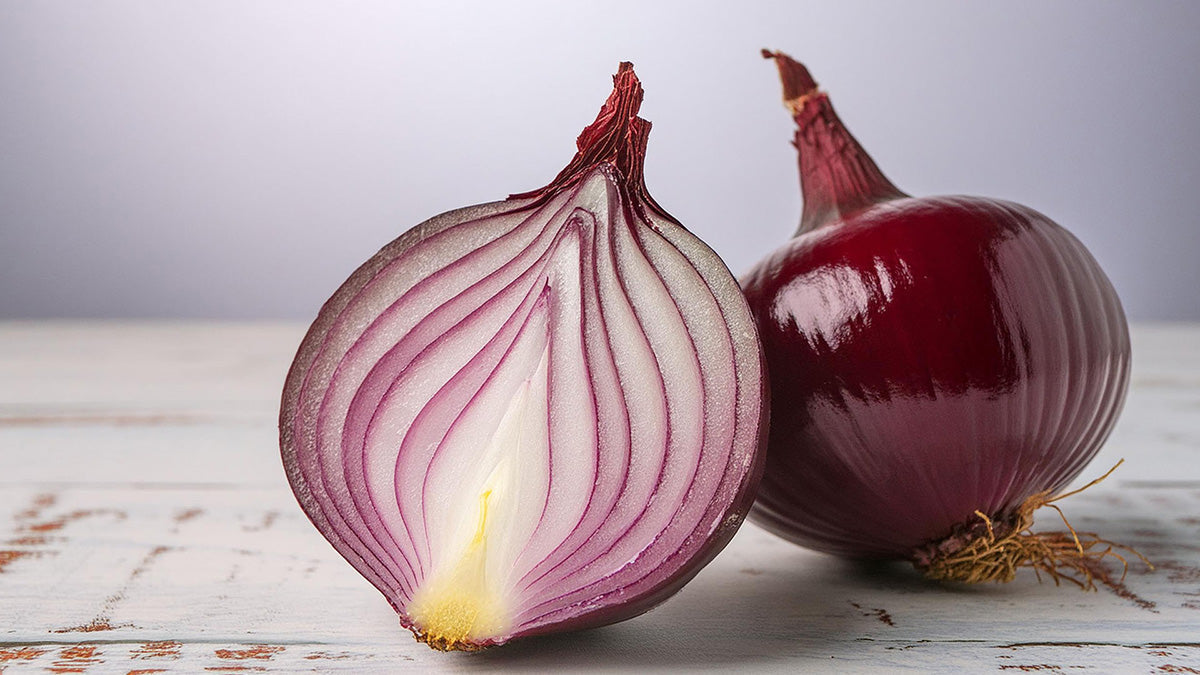


A few common kitchen staples are genuinely dangerous for dogs — and onions are among them. All members of the Allium family are toxic to dogs, including garlic, leeks, chives, scallions, and shallots. This article covers how to recognize onion poisoning, what to do if your dog has eaten onions, and why cooked and processed forms are just as dangerous as raw.
Can dogs have onions?
No. All forms of onion are toxic to dogs — red, white, yellow, sweet, and green — and cooking, drying, or powdering does not make them safe.
Onion poisoning is also more common than many owners realize. In 2025, the Allium category (which includes onions) moved from #10 to #5 on Pet Poison Helpline's annual ranking of the most-reported pet poisons, the biggest single shift on the list.
What plants are in the onion family?
Onions belong to the genus Allium, part of the family Amaryllidaceae. More than 80 native Allium species grow in North America, and every member of the genus is considered toxic to dogs. The species most likely to appear in a household kitchen are:
- Onion (Allium cepa)
- Garlic (Allium sativum)
- Scallion (Allium fistulosum)
- Shallot (Allium cepa var. aggregatum)
- Leek (Allium ampeloprasum)
- Chive (Allium schoenoprasum)

Common members of the Allium family

Common members of the Allium family
Why are onions bad for dogs?
When a dog chews or swallows onion, sulfur compounds inside the plant break apart into new, reactive compounds. Inside the dog's body, these reactive compounds damage red blood cells. The oxygen-carrying protein inside each cell (called hemoglobin) gets chemically altered and clumps into small deposits called Heinz bodies, which make the cell fragile and cause it to be destroyed early. The result is a condition where the blood doesn't have enough healthy red blood cells to carry oxygen around the body — known as Heinz body anemia, or hemolytic anemia.
Cooking and drying do not destroy these compounds, so raw, cooked, and dehydrated onions are all toxic. The same compounds are also found in garlic, leeks, chives, scallions, and shallots, which is why every member of the Allium family is dangerous for dogs.
Are processed onion products and cooked onions bad for dogs, too?
Yes. Dehydrated onion flakes, powders, and soup mixes are even more concentrated than fresh onion, so a smaller volume delivers a larger dose of the toxic compounds. Poisoning has also been documented from foods that might not immediately raise suspicion. Examples include Catalan spring onions (known as calçots), onion soufflés, butter-cooked onions, and Chinese steamed dumplings made with Chinese chives (Allium tuberosum).
"A common misconception about onions is that only raw and red onions are toxic. In fact, all forms of Allium plants — raw, cooked, dried, or powdered — are harmful to dogs."
Dr. Sasikala Vaddu, DVM
How can I protect my dog from onion poisoning?
Protecting dogs from onion poisoning comes down to two things: controlling what's in the kitchen and controlling what's in the yard.
In the house
Store onions, leeks, garlic, and other Allium plants out of reach. Many cases of poisoning happen when owners share their meals with their dogs, so always check the ingredients of anything offered from the table. Common sources of onion and garlic include:
- Pizza
- Pasta sauces and pasta dishes
- Soups, broths, and stocks
- Sauces, gravies, and salad dressings
- Baby food
- Spice blends and seasoning mixes
- Takeout leftovers, especially Asian, Italian, and Mediterranean dishes
- Some herbal supplements
Concentrated forms are especially risky because a small volume delivers a much larger dose. Examples include dehydrated onion or garlic flakes, onion or garlic powder, and dry soup mixes. Dispose of leftovers containing these ingredients in a sealed container the dog cannot access.
In the garden and yard
The garden is the other source worth thinking about. An Allium of some kind is probably growing somewhere in many American yards. Wild onion, sometimes also called meadow garlic, is common in pastures, lawn edges, and unmaintained corners of yards. Ornamental Allium plants, recognizable by their distinctive purple globe flowers, are popular in flower beds. Home vegetable gardens often include chives, scallions, and garlic. Every part of these plants is toxic to dogs, but the bulbs are the most concentrated. A dog that digs up a bulb and chews it is taking in a much bigger dose than a dog that nibbles on leaves.
A few practical steps can reduce the risk:
- Fence off garden beds that contain Allium plants if the dog has unsupervised yard access.
- Supervise dogs that dig. Bulbs are the most concentrated part of the plant.
- Learn to recognize wild onion in your yard. The leaves are grass-like, but the plant gives off a clear onion smell when crushed. That smell test is the easiest way to tell it apart from ordinary grass.
- Keep compost bins and garbage cans secured. Onion scraps in food waste stay toxic, and a curious dog can dig them out.
How much onion is toxic to dogs?
Any amount of onion can be harmful, and there is no established "safe" dose for dogs.
Because symptoms can take one to seven days to appear, owners should not wait to see whether the dog becomes ill. Any suspected onion ingestion warrants a call to your veterinarian, the ASPCA Poison Control at (888) 426-4435, or the Pet Poison Helpline at (855) 764-7661. If possible, bring the packaging or a photo of the ingredients. That helps the clinician estimate the dose and decide whether decontamination and monitoring are needed.
Toxic amounts of fresh onion
Clinical toxicity has been reliably documented at 15 to 30 grams of onion per kilogram of body weight, which is roughly 1.5% to 3% of the dog's body weight. For a 30-pound dog, that comes out to about 7 to 14 ounces of onion — roughly half a medium onion to a full one. A widely cited lower threshold for serious concern is 0.5% of body weight, which would be about 2.5 ounces for that same 30-pound dog.
The amounts below are pegged to that lower "serious concern" threshold. Smaller amounts, repeated exposures, and concentrated forms can still cause harm — treat these numbers as a reference point, not a safe limit.
- Small dogs (under 20 pounds): approximately ½ to 1½ oz of raw onion, or about ¼ teaspoon to 1 teaspoon of onion powder
- Medium dogs (20–50 pounds): approximately 1½ to 4 oz of raw onion, or about 1 to 2 teaspoons of onion powder
- Large dogs (over 50 pounds): approximately 4 to 8 oz of raw onion, or about 2 to 4 teaspoons of onion powder
Can small amounts of onion hurt a dog over time?
Sensitive dogs, dogs exposed repeatedly over time, and dogs eating concentrated forms like onion powder can be affected at much smaller amounts. Chronic low-dose exposure is a distinct pattern from a single large ingestion: a dog eating onion-seasoned table scraps over weeks may show the same pattern of Heinz body anemia as a dog that ate a whole onion at once. For that reason, the toxic-dose figures above are a guide to when severe poisoning becomes likely, not a green light for small daily amounts.
Which dogs are most at risk from onion poisoning?
All dogs can be harmed by onions, but some are at elevated risk:
- Japanese breeds such as the Akita and Shiba Inu. Research has identified a hereditary trait in these breeds that makes their red blood cells unusually fragile when exposed to the reactive compounds in onion. Other Japanese breeds, including the Japanese Spitz and Shikoku, may share this sensitivity.
- Dogs with certain inherited conditions. Some dogs are born with genetic differences that weaken their red blood cells' natural defenses. This lowers the amount of onion it takes to cause damage.
- Dogs on poorly balanced homemade diets. Certain nutrients, particularly zinc, help red blood cells resist damage from onion and other Allium plants. Dogs missing these nutrients are more vulnerable than dogs fed a complete and balanced commercial diet.
- Dogs with liver disease. The liver clears harmful byproducts from the bloodstream, including those produced when a dog eats onion. When the liver isn't working properly, red blood cells stay exposed to these byproducts longer, which makes the damage worse.
- Puppies and senior dogs. Developing and aging red blood cell systems have less reserve to absorb the damage onion compounds cause. Smaller body mass in puppies also means that any given amount of onion represents a proportionally higher dose.
What are the symptoms of onion poisoning in dogs?
Symptoms can appear on two different timelines. Mild gastrointestinal signs, such as vomiting or diarrhea, often show up within a few hours of ingestion. The more serious signs, caused by the destruction of red blood cells, usually take one to several days to develop. Heinz body anemia progresses gradually: red blood cells are damaged silently in the days after ingestion, and symptoms become visible only after enough of them have been cleared from circulation. This is why the worst signs arrive late.
Early signs of onion poisoning, typically within hours:
- Vomiting
- Diarrhea
- Loss of appetite
- An onion or garlic smell on the breath
Later signs of onion poisoning, typically within one to seven days:
- Weakness and loss of coordination
- Pale or yellow-tinged gums
- Rapid breathing
- Elevated heart rate
- Dark red or brown urine
- Lethargy and reluctance to exercise
“Because anemia can take several days to develop, a dog that appears fine in the hours after ingestion is not necessarily safe. Any suspected onion ingestion warrants a call to your veterinarian.”
Dr. Sasikala Vaddu, DVM
What should I do if my dog ate onions?
If your dog has eaten any amount of onion, or if you are not sure how much they may have consumed, contact your veterinarian, the ASPCA Poison Control at (888) 426-4435, or the Pet Poison Helpline at (855) 764-7661 right away. Onion poisoning can progress over several days, and if untreated, the damage can spread beyond the red blood cells to the kidneys. Do not induce vomiting at home without instructions from a veterinarian.

Pet poison helpline contact information
How do veterinarians treat onion poisoning?
Treatment generally follows three steps:
- Decontamination. Vomiting is induced and activated charcoal is given to limit how much of the onion compounds the body absorbs.
- Monitoring and supportive care. Blood work is checked right away and repeated over the following days to watch for developing anemia. Intravenous fluids help protect the kidneys from hemoglobin damage, and anti-nausea medication supports recovery.
- Escalation if needed. In more serious cases, oxygen therapy or a blood transfusion may be needed to stabilize the dog.
Most dogs recover within about two weeks with appropriate care.
Recommended Reading

Can Dogs Eat Carrots? Health benefits, helpful tips, and more
Carrots are a tasty and nutritious vegetable many of us keep in our kitchens, and pet owners want to know — can...

Can Dogs Eat Garlic? Toxicity risks and possible benefits
A clove falls to the kitchen floor. A slice of garlic bread gets stolen off the counter. Most dog owners aren't sure...

Can Dogs Eat Ginger? A complete guide
Is ginger a superfood for dogs? In small amounts, it may ease nausea, soothe inflammation, and boost wellness — but not all...

Can Dogs Eat Radishes? Safe servings, risks, and when to skip them
Radishes turn up in salads, slaws, and tacos for their bright colors and their peppery crunch. If your dog takes a liking...

Can Dogs Eat Yams? Facts and recommendations
Yams are packed with nutrients for humans — but are they safe for dogs? Learn how this humble tuber can benefit (or...


Conclusion
Onions and other members of the Allium family should never be given to dogs, whether raw, cooked, dried, or as flavoring in other foods. Before sharing any food from the kitchen, take a moment to read the ingredient label for hidden sources of onion.
If you ever suspect your dog has eaten something harmful, contact your veterinarian, the ASPCA Poison Control at (888) 426-4435, or the Pet Poison Helpline at (855) 764-7661 right away. The earlier treatment begins, the better the outlook.
Author