

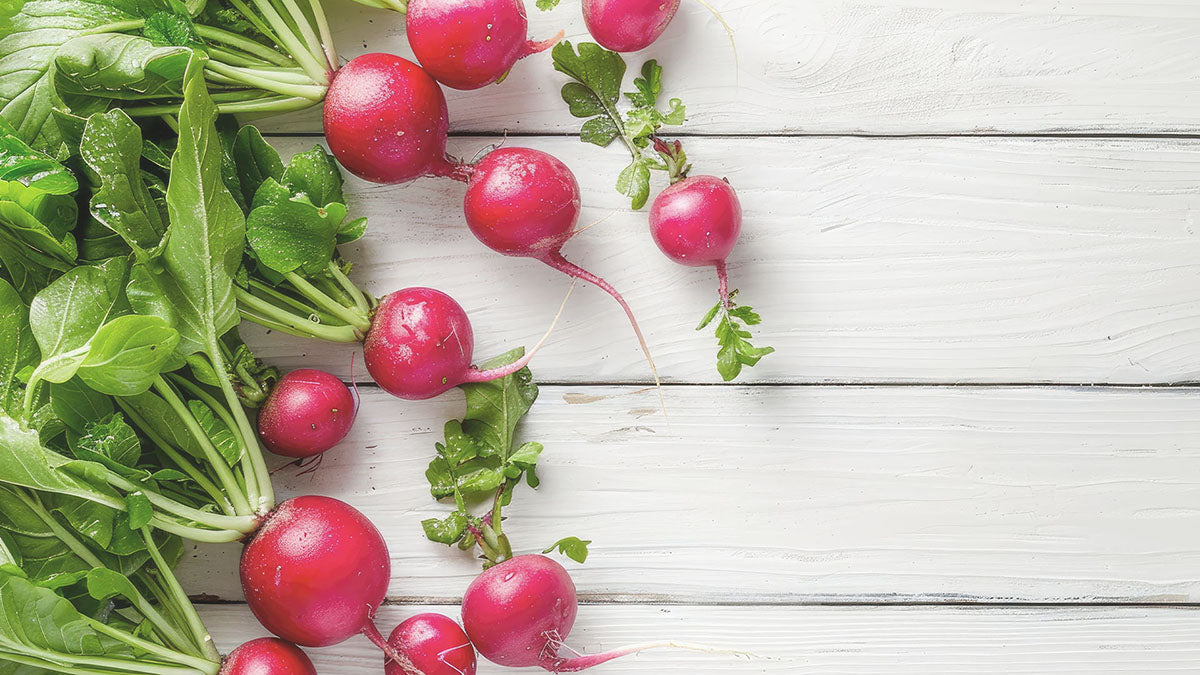


Radishes turn up in salads, slaws, and tacos for their bright colors and their peppery crunch. If your dog takes a liking to them, plain radishes are safe to share in small amounts — though most dogs aren't enthusiastic about the spicy flavor. Here's how to serve them safely, and when to skip them.
Can dogs have radishes?
Yes, dogs can eat plain radishes in moderation. Radishes are not toxic to dogs, but they're also not a food most dogs are likely to enjoy, and the nutritional benefits in the small amounts a dog would realistically eat are modest. Sharing radishes is fine — but there's no reason to make a point of it.
What is a radish?
Before getting into nutrition and serving, a quick orientation. "Radish" covers a wider range of plants than the small red ball most people picture, and a couple of radish-adjacent foods sold in U.S. stores aren't actually radishes at all.
Radishes belong to the mustard family
The cultivated radish, Raphanus sativus, is a root vegetable in the family Brassicaceae (also known as the mustard or cabbage family). It's the same family that includes broccoli, cauliflower, cabbage, kale, Brussels sprouts, kohlrabi, turnips, and arugula. The shared family trait is a group of sulfur compounds that give Brassicaceae vegetables their characteristic peppery, sharp, or bitter flavors. In radishes, these compounds are concentrated in the skin and leaves, which is why those parts taste sharper than the inner flesh.
Two radish-adjacent plants are worth flagging because the names cause confusion. Horseradish (Armoracia rusticana) is in the same family but a different genus, so it isn't a radish at all. Wild radish (Raphanus raphanistrum) is the same genus as cultivated radish but a different species, and it grows as a weed throughout much of North America.
Common radish varieties
There are hundreds of named radish varieties worldwide, but a handful account for almost everything sold in U.S. grocery stores:
- Red globe (Cherry Belle) — The small, round, red-skinned, white-fleshed radish. The most widely sold variety.
- Easter egg radishes — A mixed bunch of small radishes in white, pink, red, and purple. Not a single variety but a marketed seed blend.
- French breakfast — Oblong, red with a white tip, milder than red globe.
- Daikon (white, winter, or Japanese radish) — Long, white, carrot-shaped. Mildest of the common types.
- Watermelon radish — A daikon heirloom with green skin and bright pink flesh. Sweeter and milder, with a flavor that mellows as the radish matures.
- Black Spanish (black radish) — Round or oblong, with rough black skin and white flesh. The strongest, sharpest flavor of the common types.
- Korean radish (mu) — Shorter and stouter than daikon, with a green-shouldered top and denser flesh.
All of these are safe for dogs in moderation. Milder varieties like daikon, watermelon radish, and French breakfast are usually better tolerated than the sharper red globe or black Spanish.
Are radishes good for dogs?
Plain radishes can contribute small amounts of fiber, vitamin C, and a few minerals to a dog's diet. In the quantities most dogs would actually eat (a teaspoon to a tablespoon), the nutritional contribution is modest. The case for sharing radishes is mostly about variety and a low-calorie crunchy treat, not meaningful nutrition.
Nutritional facts about radishes
According to the U.S. Department of Agriculture, 100 grams of raw radishes (about 3.5 ounces, or roughly 10 medium red globe radishes) provide:
- 16 calories
- 95.3 grams of water
- 3.4 grams of carbohydrates
- 1.6 grams of fiber
- 25 mg of calcium
- 10 mg of magnesium
- 233 mg of potassium
- 14.8 mg of vitamin C
- 1.3 µg of vitamin K
Health benefits of radishes for dogs
Most of these benefits are small at the portion sizes a dog would realistically eat, but they are real:
-
Fiber and digestion
Radishes are mostly water and provide modest dietary fiber, which can support normal stool quality and help dogs feel full on fewer calories. -
Vitamins and minerals
Radishes contribute small amounts of vitamin C, vitamin K, calcium, and potassium, which play roles in immune function, blood clotting, bone health, and muscle function. Unlike people, dogs make their own vitamin C in the liver, so dietary vitamin C is a small bonus rather than a need. -
Low calorie
At about 16 calories per 100 grams, radishes are one of the lighter vegetable options for dogs and don't cause meaningful blood sugar swings, which makes them a useful choice for dogs on a weight-management plan.
“Radishes are safe for most dogs in plain, small portions — but they're not a food most dogs will choose to eat, and there's no nutritional reason to push them.”
Dr. Max Gordon, DVM
Can radishes be bad for dogs?
Radishes are safe for most dogs, but a few things are worth knowing before sharing:
- Peppery flavor — Some varieties may not sit well with dogs that have sensitive stomachs.
- Choking and obstruction risk — Whole radishes and large chunks are a hazard, particularly for small dogs and dogs that swallow food without chewing.
- Leaves and stems — Tougher to digest than the root, and can cause mild stomach upset in some dogs.
- Too much at once — As with any new food, overdoing it may cause gas or loose stools.
How to safely feed your dog radishes
The safest approach is plain and simple — no salt, oil, butter, garlic, or onion. Both fresh raw and cooked radishes are fine; pick whichever your dog prefers.
Fresh radishes
Plain raw radishes are easy to prepare. Wash thoroughly to remove dirt and pesticide residue. Trim off the leaves and any tough root fibers. Slice or dice into small pieces, pea-sized for small dogs and a bit larger for medium and large dogs, to remove any choking or obstruction risk. If your dog is new to radishes, milder varieties like daikon, watermelon radish, and French breakfast are usually better tolerated than the sharper red globe or black Spanish. Grated radish also works well as a food topper.
Cooked radishes
Roasted, baked, microwaved, blanched, or boiled radishes are another option, especially for dogs that find raw too sharp. Cooking mellows the peppery flavor and softens the texture, which can also help senior dogs or dogs that struggle with crunchy foods. Always let cooked radishes cool fully before serving.
Radish leaves and stems
Radish leaves and stems are not toxic to dogs, but they aren't the best part of the plant to share. They're more fibrous than the root, contain higher concentrations of the sulfur compounds that make radishes spicy, and have been associated with mild stomach upset in some dogs. The simplest rule is to remove the leaves and stems before offering radish to your dog, and to discard them rather than feed them as a separate snack.
A note on wild radishes
Wild radish concentrates the same sulfur compounds as cultivated radish but at higher levels, which makes it considerably spicier and more likely to cause stomach upset. It's best skipped.
A note on horseradish
Despite the name, horseradish (Armoracia rusticana) is not a radish. It's a different plant in the same family, and the eye-watering pungency familiar from prepared roast beef and cocktail sauce can cause stomach upset and oral irritation in dogs. Do not feed.
Which radish foods should dogs not eat?
Plain radishes are safe, but most of the radish-containing foods in a human kitchen are not. Common preparations add salt, sugar, vinegar, oil, or other ingredients that can upset a dog's stomach or cause more serious problems.
- Pickled radishes — Skip them. The vinegar brine can irritate a dog's gums and stomach, and the added salt makes the problem worse.
- Sautéed or fried radishes — Don't share. Cooked in oil or butter, often with garlic or onion, and both garlic and onion are toxic to dogs.
- Radish coleslaw and salads — Off the menu. Mayonnaise is high in fat (a known pancreatitis trigger), and these dishes typically also include sugar and onion-family ingredients.
- Kimchi and other fermented radish dishes — Not for dogs. Heavy on salt, with chili that directly irritates a dog's stomach and garlic and onion in the mix.
- Radish-leaf pesto — Avoid. Loaded with garlic, plus hard cheese and oil that together push the fat content well above what a dog should eat.
How many radishes can a dog eat?
If your dog enjoys radishes, treat them as you would any other low-calorie occasional treat. Veterinary nutrition guidance from UC Davis recommends that treats and extras make up no more than about 10% of a dog's daily calories. Radishes fit easily within that limit because they're naturally low in calories, so the practical concern is digestive upset rather than calories. When introducing radishes for the first time, start with a very small piece, and stop feeding radishes if your dog shows any signs of stomach upset.
For dogs that enjoy radishes, reasonable portion sizes are:
- Small dogs (under 20 pounds): ½ teaspoon of diced or grated radish
- Medium dogs (20–50 pounds): 1–2 teaspoons of diced or grated radish
- Large dogs (over 50 pounds): 1 tablespoon of diced or grated radish
Feeding frequency
Radishes are best offered as an occasional treat rather than a daily food. A small portion two or three times a week is plenty for a healthy dog that enjoys them. The goal is variety on top of a complete and balanced diet, not a regular addition to it.
Recommended Reading

Can Dogs Eat Carrots? Health benefits, helpful tips, and more
Carrots are a tasty and nutritious vegetable many of us keep in our kitchens, and pet owners want to know — can...

Can Dogs Eat Garlic? Toxicity risks and possible benefits
A clove falls to the kitchen floor. A slice of garlic bread gets stolen off the counter. Most dog owners aren't sure...

Can Dogs Eat Ginger? A complete guide
Is ginger a superfood for dogs? In small amounts, it may ease nausea, soothe inflammation, and boost wellness — but not all...

Can Dogs Eat Onions? Recognizing and preventing Allium poisoning
A few common kitchen staples are genuinely dangerous for dogs — and onions are among them. All members of the Allium family...

Can Dogs Eat Yams? Facts and recommendations
Yams are packed with nutrients for humans — but are they safe for dogs? Learn how this humble tuber can benefit (or...


Which dogs should not eat radishes?
Like people, dogs are individuals, each with their own health needs and sensitivities. Plain radishes are typically safe, but a few groups of dogs should eat them only in very small amounts, or skip them entirely.
Puppies
Because puppies have more sensitive digestive systems, new foods should be introduced gradually and in very small quantities, with close monitoring for any signs of stomach upset. The peppery flavor of many radish varieties may also not appeal to puppies, so daikon is the safest first introduction if you do choose to offer one.
Senior dogs and dogs with specific health conditions
Senior dogs are more likely to have underlying conditions that change what's safe to share. Dogs with a history of calcium-oxalate bladder stones should generally avoid radishes, since high-oxalate foods are a recognized risk factor for stone formation in dogs. Dogs with thyroid conditions may also be advised to limit cabbage-family vegetables. Consult your veterinarian before sharing radishes with your dog.
Dogs with allergies or sensitivities to radishes
Although uncommon, some dogs may develop digestive upset or skin irritation after eating radishes. If your dog shows signs such as vomiting, diarrhea, itching, or hives after a radish, stop offering them and contact your veterinarian.
Summary
Plain, fresh radishes are safe for most dogs, but they aren't a food most dogs will go out of their way to eat, and they don't need to. The nutritional contribution in the small amounts a dog would actually eat is modest, and a dog who turns up their nose at a slice of radish isn't missing anything important.
If your dog does enjoy the peppery crunch, share small portions of fresh raw or cooked radish, skip the leaves and human preparations, and treat it as one option among many in a varied treat rotation. Milder varieties like daikon, watermelon radish, and French breakfast are usually better tolerated than sharper red globe or black Spanish. As with any new food, start small and watch for any signs of digestive upset.
Author